Joe Matt's Peepshow & Dead Ends
Three years ago, after the cartoonist Joe Matt died, I wrote about the depressing metanarrative running through his work. It was probably too soon but it was also something I'd been thinking about for a decade. That ran on my Substack, which I abandoned four months later, as the company made it clear they weren't going to do anything about their Nazi problem, which they never fixed. Joke's on me, now I've got zero readership growth because you can only find my newsletter if I send you a direct link. Not the first time I shot myself in the kneecaps for my principles. Also, I don't blame anybody for staying on that platform. Some of my best friends, etc.
Anyway, I'd like to revise that post and bring it over here. A few weeks ago, Fantagraphics released an omnibus of Matt's series Peepshow, covering the 14 issues Drawn & Quarterly published and the posthumous 15th one Fantagraphics put out in 2024. The new book doesn't include any of the work Matt made pre-1992, but that work, originally collected by Kitchen Sink, needs to be printed in a larger format. I assume it'll get its own book if the new collection does well enough.
If you aren't familiar, this is the comics memoir of a compulsive masturbator and cheapskate who is or writes himself to seem like a total asshole. Reading Peepshow as a brick of work spanning 22 years of a person's life, it's weird. I wouldn't have assumed it would feel so much different from reading the same material divided into three discrete books, which is how I originally encountered it.
In my initial post, I opened with this:
Two weeks ago, I read an autobiographical comic acclaimed for its frank discussion of mental health, mixed media artwork, tweaks to the staid memoir format and all the other reasons people love autobiographical work in 2023. It failed in a few bigger ways, but what really killed it for me was the author recounting times other people she admired called her "the future of comics." There was some forced plausible deniability in the dual humblebrags of embarrassment ("I don't even know how to respond when I get effusive praise!") and the potential for unmet expectations ("My favorite artists love me, but all of this constant admiration makes it difficult to complete my current projects!"). Reading somebody relay other people's applause quickly felt like reading a book whose cover blurbs were on the inside. I don't want people to hate themselves and I'm not saying some positive self-regard is poisonous, but it can get rough when a book ostensibly about depression comes out as Oops! All Adulation. The memoirist makes discoveries about herself, but none of them feel earned– it's clear she knew what lessons she wanted to learn and what conclusions she wanted to reach. It's a need to bend one's life to the structures of regular plots, and part of what David Berman called "storyline fever."
My favorite comics memoirists are people like John Porcellino, Keiler Roberts, Julie Doucet, Lynda Barry, MariNaomi, Anders Nilsen, Justin Green and Harvey Pekar, people who embrace the messiness of the world and can write about a particularly nasty period of self-doubt without also trying to get that story to conform to three act structure. When these people describe times they fell on their faces, they also write about getting up bruised and are unafraid to follow thematic digressions about seeing groundhogs or stealing underwear from a member of Duran Duran because the point is to document some aspect of life, not to force an epiphany that ties everything they’ve ever done into a fable. Their honesty means that sometimes they don't come off completely likable, which means they come off as people.
The cartoonist Joe Matt died last week, though his last complete, published comic was released 17 years ago. Matt's work, unlike the other writers I mentioned, was entirely autobiographical and is largely collected in four great books released between 1992 and 2007. The last one, Spent, has haunted me for years.
It took a minute to remember, but the bad memoir I was talking about was It's Lonely At The Center Of The Earth by Zoe Thorogood. Really well drawn, technically, but the humblebrags are the only thing that stuck with me.
The same day I sent my thing off on Substack, The Comics Journal posted a series of mostly beautiful Matt remembrances (the Seth one'll choke you up) and the people who knew him best are clear some of the Peepshow material wasn't totally autobiographical and was actually embellished by Matt to make himself look worse. That's something to keep in mind as I write this.
From here, I'm going to mix the original post with new thoughts. Hope that's cool with you.
**
Matt's first book, Peepshow, collected one-off strips that admitted to feigned embarrassment at being cheap and jerking off a lot. Sometimes Matt experimented with form, but mostly he crammed as many panels as he could into every oversized page, creating grids of postage stamp-sized boxes of pain.
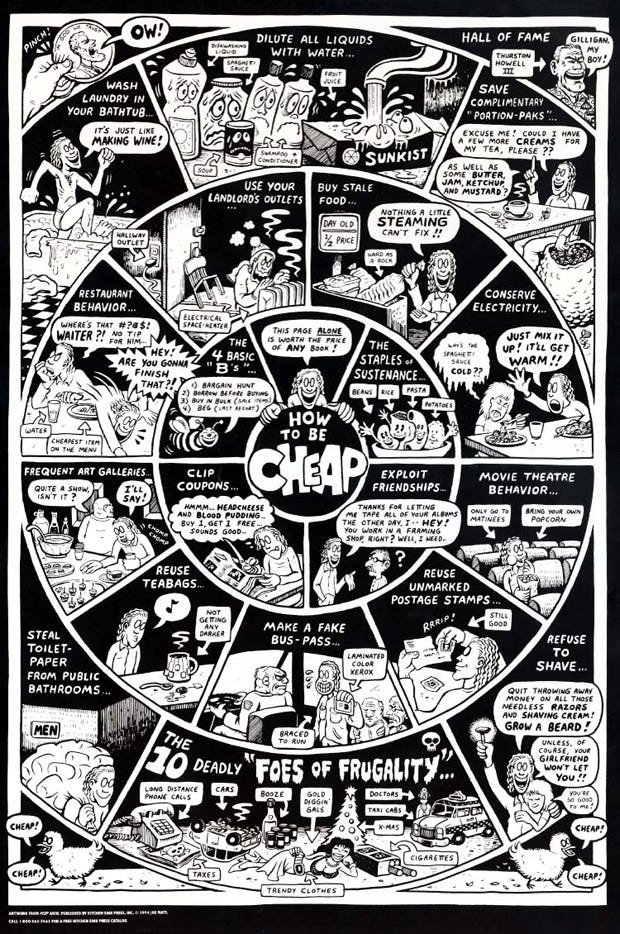
From here, Matt turned Peepshow into a floppy comic series. Its first arc, The Poor Bastard, ran six issues released between 1992 and 1994. Matt lived in Toronto and had a contentious relationship and eventual breakup with a woman he called "Trish" in the comics. The truly fascinating part of this arc comes toward its end, when the first few issues of Peepshow have begun to come out and the people Matt's writing about have seen his version of events. A couple Matt's friends with realizes he's been lusting after her and calling him a doofus and they're furious. In the span of that one story, you read about the creation of and fallout from the art you’re experiencing. You read a person blow their life apart. He'll meet people, treat them horribly, they'll realize he's an asshole, he'll wonder why he is how he is. Everybody chastises Matt and they're all right.
The next arc, Fair Weather, covers four issues released over another three years, but barely touches on what Matt was actually doing from 1995-1997. He uses the arc to reminisce about his childhood in suburban Pennsylvania.
And then the final arc, Spent. After averaging two published issues of Peepshow per year, Matt’s output slowed to a crawl and he released 4 issues in eight years. He published 20-page-long comics in 1998, 2000, 2002 and 2006, and they're all about living in a boarding house, editing borrowed porn into dozens of VHS compilations, peeing in bottles and talking with friends Chester Brown and Seth, two artists who have appeared in Matt's other work and have by 1998 rocketed ahead of him in acclaim, productivity and sales.
The art in Spent is good, but it's repetitive, talking head stuff. When things happen, they tend to happen off-panel, meaning you're often reading five-to-six page stretches where the same three characters sit around a table and recount what they did with their days. More than ever before, Joe Matt's presenting himself as truly unlikable. His hero Robert Crumb would go "I'm racist and sexist but ain't I a stinker?" There's no winking at the audience with Matt. There's zero irony here. And there’s no Larry David-style “I may have gone about this the wrong way, but I was right, right?” justification. He really believes it's normal to be in your 40s, horning after Asian teens who are too stupid to share his taste in art.
In the last chapter of Spent, which, again, took four years to come out, Matt recognizes how poor his work ethic has become. He admits that part of his second book didn't happen in real life and, infinitely more damning, that his third book peters out at the end because he was too lazy to draw the climax as he had initially intended. The story is forever compromised because Matt didn't care. After some moaning and groaning, Matt walks to his boarding house's shared bathroom and the book ends.
In the final Peepshow letters column, Matt says he's since moved to Los Angeles to work on a failed HBO pilot adapting his work. He promises to tells his LA stories in future issues of his comic, but nothing ever came. In 2015, a few unreleased Matt pages were published in the perfect book Drawn & Quarterly: 25 Years of Contemporary Cartooning. An intro explains that not only are these pages the only progress Matt's made in the past nine years, but he's unhappy with them and he'll have to start from scratch when he returns to the drawing table. So they weren’t concrete progress toward another new comic, they weren’t an excerpt, they were another dead end.
Eight years later, nothing else had been finished and Joe Matt was dead. When Fantagraphics put out that posthumous issue, a fair chunk of its material had actually originated in the D&Q25 book, and I'm not sure if that owes to Matt reconsidering those pages, or if there just wasn't enough other stuff available to pad out a full comic. Whatever the reason, it sure feels sad.
There's the self-aggrandizing humblebrag memoir, which I have no use for, and there's the honest, meditative memoir, which I love, and then the blatantly ugly memoir that works to reduce any filter between an artist's brain and their expression, which, as a voyeuristically fascinating and abrasive form, makes me feel intensely weird. That type was maybe only really mastered by Joe Matt. He wrote he was reaching a dead end and then he hit it.
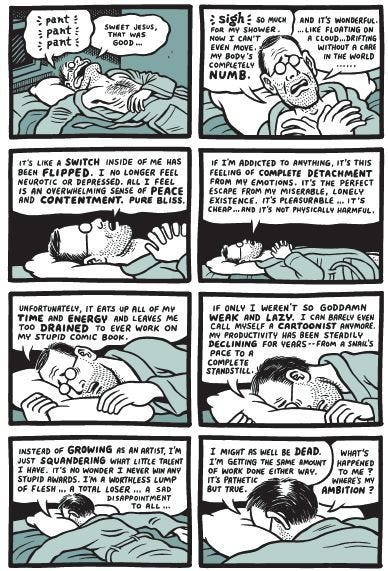
There's better art about writer's block and hitting dead ends, but all of that fear and self-loathing and doubt ultimately stays in the art itself. Michael Chabon wrote about writer's block but it was his breakthrough. His next book won him a Pulitzer. Charlie Kaufman wrote a screenplay about it and was nominated for an Oscar. The Coen brothers channeled their Miller's Crossing writer's block into Barton Fink, taking a break from one masterpiece to create another. The character Barton Fink is in an endless hell, but the people who created him to deal with their own dead end quickly went on to become two of the most famous and productive filmmakers alive and now I back myself into mentioning them every other issue of this newsletter. There is no shortage of art about this topic, but you're usually able to see it because the artist responsible broke through to the other side.
Not Joe Matt. He was ambitious out of the gate, began to flag after a few years and then, if you were a reader, he vanished. In the final chapter of his final book, he acknowledges that he's succumbing to his addictions, but these aren't addictions that kill you. It's possible to both burn out and fade away, to implode and then walk around for another 17 years. Matt declared himself an avatar of unfulfilled potential but couldn't pull it together enough to fix the problems he had self-diagnosed. He saw the dead end coming and couldn't help but drive right up to it.
When I think of releasing anything as a form of victory against the block, I realize that's part of my attraction to Peepshow, even as I find Joe Matt repellant.
(Or at least I find the version of himself he presents in his comics repellant, though I followed the guy on social media for a while and he was writing Facebook posts about getting kicked out of a coffee shop for mansplaining Woody Allen to a barista, so I'm not sure how much slack he should be given.)
I value a look at a person who lives like Matt did because that kind of person usually can't pull their shit together enough to publish anything. Adaptation and Barton Fink and pretty much anything else I could cite about a creative block, these are about people writing books and screenplays. It's well-trod territory. The perspective's tired. There aren't a lot of clear-eyed first hand accounts of pissing in bottles because using the toilet would cut into your jerk-off time, and of having to live hand to mouth due to a combination of not wanting to work and being psychically unable to do so. If you want to read about that kind of person's life, you're probably going to get, at best, a novelist imagining how they live.
I relate to Matt in the abstract– I've got shame and insecurity and a tendency to self-sabotage, but none of these things originated from where his similar feelings seemed to have come from. It bums me out that somebody so talented sunk further and further into himself until it was too late. And it was too late for almost two decades. Because as annoying as I think he'd be in real life, he was funny, he was a good artist, he usually had good timing, he was, to some extent, more honest than the next person. I do think he was talented. I've worked bad jobs, neglected my own creative passions, retreated to laziness when an hour of work would have done a world of good for me, and I've wondered "Am I getting too close to Joe Matt?" There is a generosity in laying your negative aspects so bare, but there's also a little bit of violence there, a little whisper in the reader's ear that says "This is possible."
This is actually something I disagree with one of the big collection's blurbs about. The new omnibus' back cover has this quote from Tom Scharpling:
"Joe Matt erased the line between what should and should not be shared with an audience, which in turn made the reader realize that perhaps they didn't need to be so fearful of their own dark secrets."
It's the opposite for me, because when I find something to relate to in Matt's work, I feel like total shit. God damn, this racist weirdo who mentally rejects a 19-year-old "Oriental" girl because she has muscular calf muscles, that guy has the garbage work ethic I've had at times? This guy who, like me, will spend hours paralyzed in front of his bookshelf, wondering whether he needs to get rid of something he'd ultimately buy again in a year also justifies feeling morally superior to most of the people who like his work? I do the first one of those! I never want to do the second. It doesn't make me realize I can be less fearful of my own dark secrets, it makes me more afraid of them, it makes me think I can relate too much to this guy who emotionally manipulates every woman he spends more than 5 minutes with. It's how I would feel if my taste in music lined up perfectly with Elon Musk's or if Jared Leto sent me an email like "Hey man, I actually process nostalgia in the same way you described in your newsletter!"
I don't think Joe Matt was bad in this way, but here's an example from a slightly different direction that popped into my head as I thought that paragraph through. A couple years ago, a friend shared somebody else's comic on Instagram and I immediately clocked it as a Far Side rip-off.
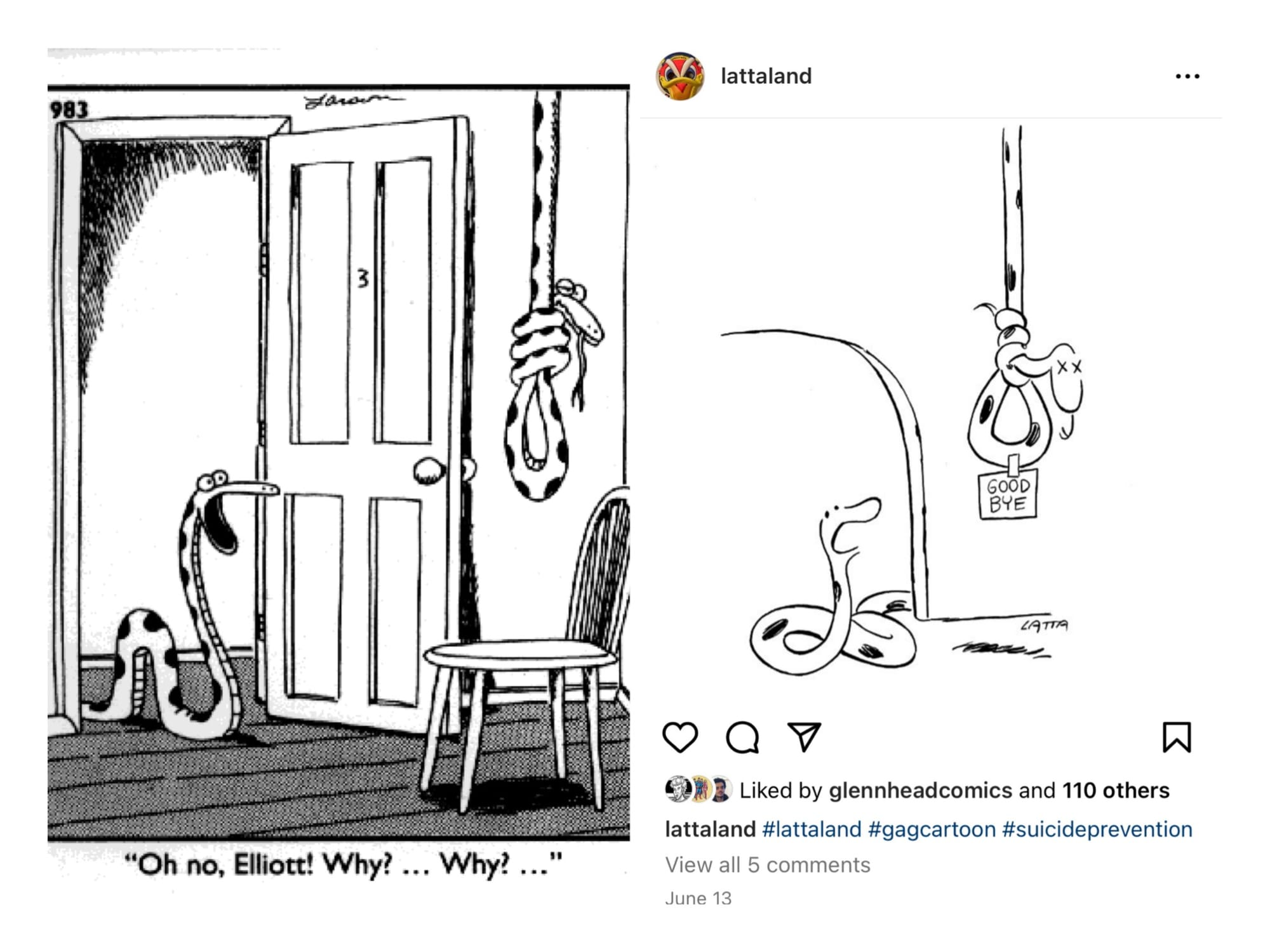
I was kind of a prick in my response, and that's on me. Plagiarism always sets me off.
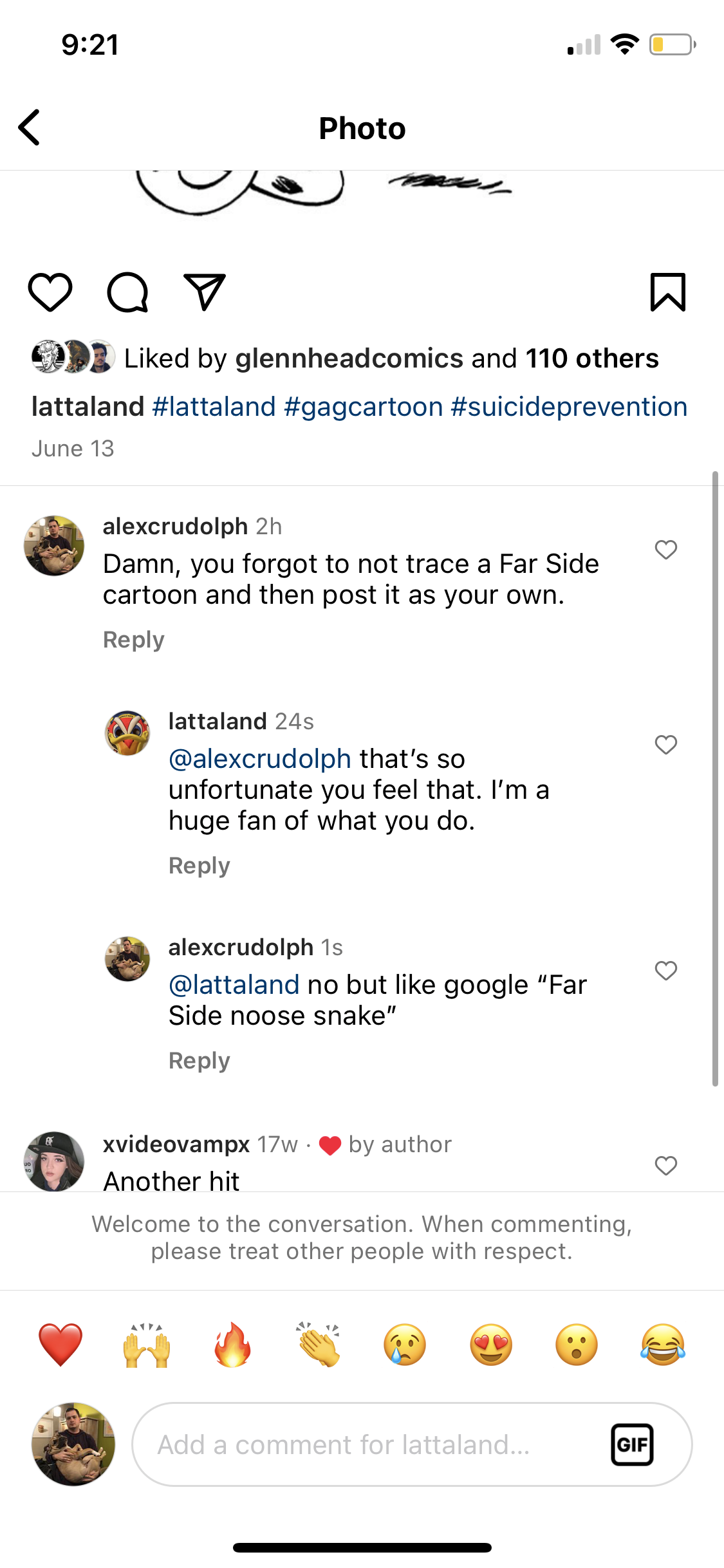
And then I spent the next 13 hours, no joke, getting snarky comments from this guy on all my posts. He compared me writing intentionally bad New Yorker caption contest entries with a cuckold and I still have no idea what that's supposed to mean.
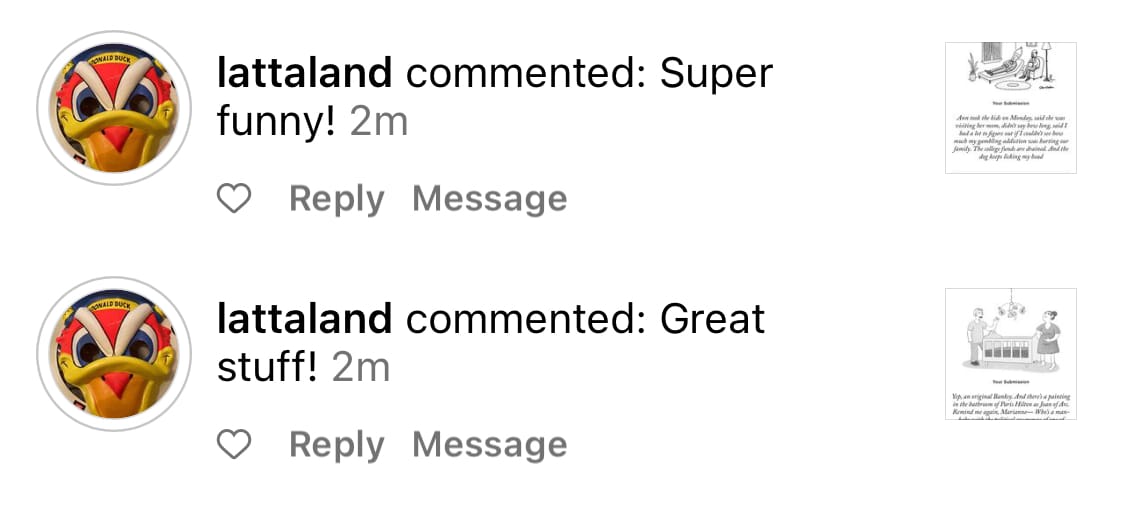
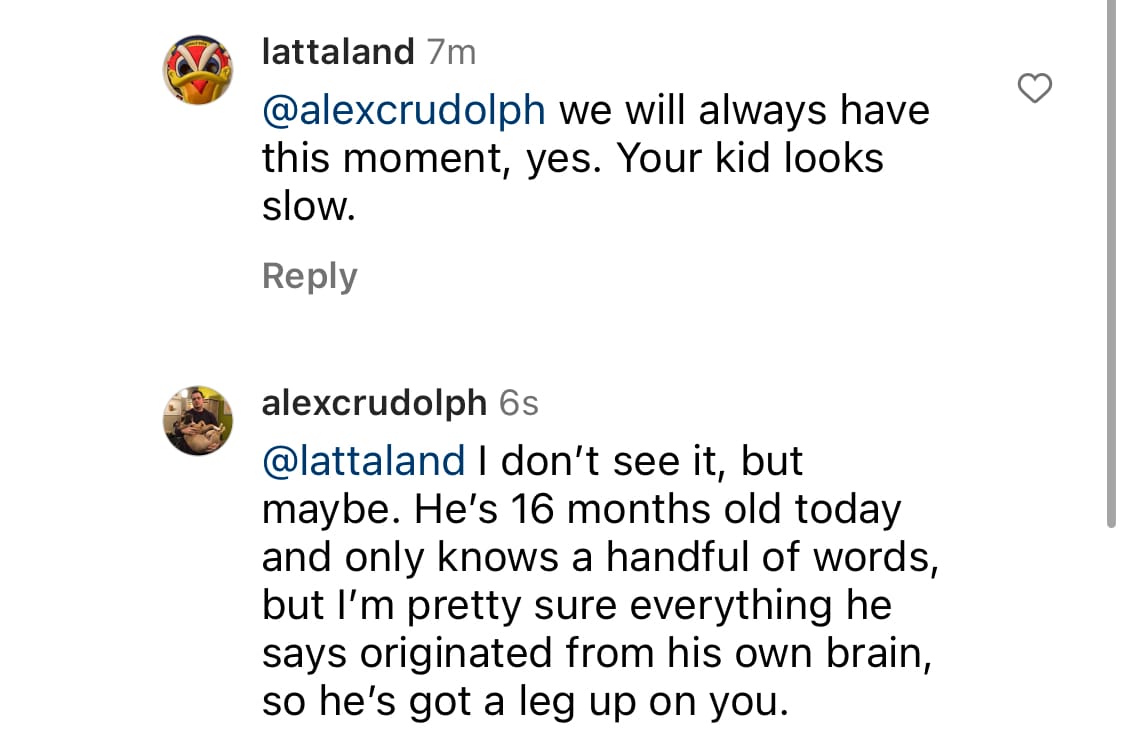
This cool guy, Josh Latta, insulted the way my baby looked, asked if my wife had drunk during pregnancy, stuff like that.
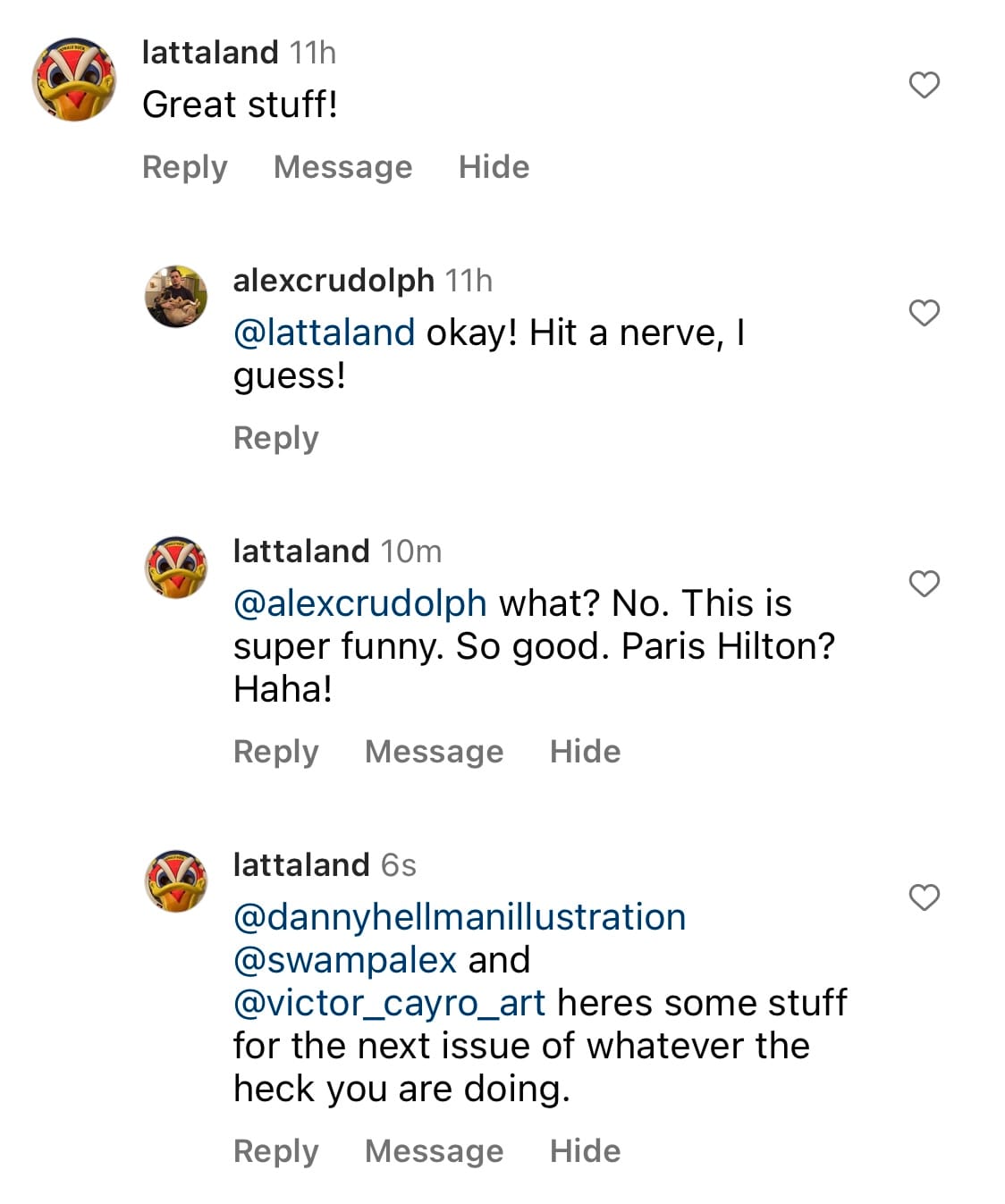
He tagged some cartoonist friends to come watch him make fun of me.
So I'm setting all of this up for a reason. None of this got under my skin, as I was dealing with a total piece of shit. If you have no respect for a person and then they say you aren't funny, it doesn't mean anything to you. When the sidewalk preacher says you're going to hell, you don't feel bad because your values are diametrically opposed to theirs. If a racist calls you ugly, you'd have to have the same beauty standards as a racist or put any stock into the opinions of a racist to be like "man, I guess I really shouldn't leave the house." You've already established you don't care what they think, why would you make an exception for their take on your brain?
The only thing that bothered me here was he saw I was wearing a Silver Jews shirt in one of the many pictures he commented on, and mixed in with the insult there, he wrote "But keep listening to the Silver Jews." And that was annoying, that was the thing that reminded me of this just now, because I don't care if a loser disagrees with me, but it stings if a loser agrees with me, if our two circles become a Venn diagram for even two pixels of overlap. People who plagiarize internationally famous newspaper comics listen to my favorite music.
Again, I don't think Joe Matt is a detestable person. I don't think I'd have wanted to spend more than half an hour with him, but I think he was more socially broken than actively malicious. And I don't think Scharpling's wrong in his opinion. I'm sure he's being sincere when he says Matt's dark secrets helped him come to terms with his own. I'm really enjoying reading this 500 page Peepshow bible, but I have to admit it'll sit on my shelf as a warning, a reverse psychology self-help book, a grim vision of a great artist who spent all that time developing their voice and then opted to make a living doing nothing rather than use that voice.