Weird Scenes Inside The Gold Mine (Oliver Stone's The Doors)
Burning out my subscribers' good will with 4,303 words on a movie that's pretty fun, I guess.
I watched Oliver Stone's The Doors for the second time. It's a film I like for reasons entirely unpredicted by the cast and crew. I know what Oliver Stone thought he was making, but his ideas are so far from why I like The Doors that this may as well be about a fictional band. He doesn't know he made a comedy that becomes a tragedy, where the worst asshole ever makes a bunch of people's lives worse.
On my first viewing, in 2009 or 2010, I thought the film was refreshing and semi-subversive, that it was puncturing a myth. I thought Stone loved The Doors but wanted to make a movie about the personification of the dark side of the American dream, or however he would have put it in in interviews with reporters given to immediate erections at the phrase "dark side of the American dream." I thought he saw Morrison as a cautionary tale of a guy who bought his own type to a fatal degree, that he thought The Doors were brave and revolutionary for flipping off The Ed Sullivan Show (and, by proxy, the Greatest Generation), but that Morrison let himself fall apart pretty quickly after that. Come see what alcohol and the world's expectations will do to a person. And this was naive of me, because the first time I watched The Doors, I was taking a college class about American history through the lens of Oliver Stone's filmography.
In this class, taught by a guy Stone was making a Showtime documentary series with, we watched the following movies, ordered chronologically, to the best of my memory:
- Platoon
- Born on the Fourth of July
- Heaven & Earth
- The Doors
- JFK
- Nixon
- Talk Radio
- Wall Street
- Natural Born Killers
- World Trade Center
- W.
It would have been funny if the professor had tried to work Conan the Barbarian in there. "In Oliver's history of America, there's Vietnam, which hints at and then fully gives way to the overt political corruption of the 70s, at which point Thulsa Doom crucifies the Cimmerian on the Tree of Woe, acting as the direct provenance of 80s yuppie greed."
I'm generally bad at noticing wigs. I'm as bad at noticing them as I was at picking up on the level of sincerity in The Doors. But the professor of this class had a jet black toupee. I think about it still.
I haven't seen any of those movies since the class, but I'd say I like maybe four of them. We had to watch these things in one of the library's media room and I will now, 16 years later, cop to having fallen asleep during Heaven & Earth. If American University would like to rescind my BA degree– a major in print journalism with a double-minor in poetry and literature– as The World finds out I wrote a paper on a movie I half-slept through, they will do absolutely nothing to my job prospects. No Hiring Manager has ever looked at my resume and thought Oooh, just what the doctor ordered, a lit minor.
As I was coming off Platoon, Born on the Fourth of July and the parts of Heaven & Earth I was awake for, knowing JFK was on deck, I thought Stone had approached The Doors as a warning. Maybe it was his Taxi Driver. Because, even without having those other movies for context, you watch this one and Jim Morrison (Val Kilmer) is an asshole. He treats every other character terribly. He starts fights with strangers over nothing. He openly cheats on and then abuses his girlfriend, Pamela Courson (Meg Ryan). His pretentious short at UCLA Film School gets clowned on by his peers and it's hard to disagree with them, but this isn't even Stone saying Morrison was at that point raw and had to work to find his voice. It's Stone saying Morrison was always a misunderstood genius.
In the film's third scene, Morrison walks around Venice with a book. He picks it up, reads about two words and then keeps walking. He's noticed Courson and he wants to sleep with her. And that's the Jim Morrison of this movie: a guy who wants to be seen with a book but doesn't want to actually read one. Later, he threatens to kill himself unless Courson says she'll die for him. It's impossible to have any empathy for that. I don't know how you put it into a movie like "See how beautifully intense he was?"
Shitting on the band The Doors is easy and expected, which doesn't make it wrong, which doesn't make defending The Doors interesting. They'll always show up on Rolling Stone-type lists, so you can never call them underrated, but pretty much everybody agrees Morrison sucked.
I like a few scattered Doors songs. I think the beginning of "Break On Through (To The Other Side)" is an immediately engaging rush. The "everybody loves my baby" part is catchy. I think the lyrics of "The End" are mostly dumb, and I don't know how anybody could ever nod along, like "yes, somebody's finally putting my feelings into words, 'ride the snake to the lake, the west is the best,'" but the wandering guitar and drums are as hypnotic as Stone thinks Morrison is. "Touch Me" is great and I wish a Stax or Motown singer had covered it. If you took the keyboard solos out of these songs, they'd all immediately improve. The truth is The Doors are no better or worse than any number of 60s and 70s bands like Procol Harum or The Animals. As far as bands with forced mysticism, great drummers and abysmal lyricists, I'd listen to The Doors before I'd listen to Led Zeppelin.
I'll agree The Doors could be pretentious, but the worst? So much truly terrible music glides on past us. Have you heard white a cappella groups covering rap songs? Have you heard "Code Monkey" by Jonathan Coulton or "King of Spain" by Moxy Fruvous? I know naming hellish things does not make a merely bad thing better, but it does indicate the world can calm down with its hyperbole.
Ray Manzarek is probably worse than Morrison, though Manny gets a few points for producing the first X albums. I've long wanted to read The Poet in Exile, his 2001 novel where Jim Morrison reveals his death to be a hoax and comes back to thank Ray Manzarek for keeping the spirit of The Doors alive in his absence. I like the scene early in this movie where Morrison recites some lyrics to Manzarek (Kyle MacLachlan) and Manzarek says "great lyrics, man" even though he's heard about six words. Even at that point, Manzarek is talking about The Doors as a way to shamanistically address Vietnam, both because that's who Manzarek was in real life and because that's what Oliver Stone thinks the band did. Also, maybe Oliver Stone served in Vietnam and wanted to talk about it in a movie? Hard to know. He's famously never said whether he went to Vietnam.
When The Doors was released, Stone was the king of the movie sold on two VHS tapes, but this thing moves well. The 2 hours and 20 minutes don't feel like a serious block of time, but or because the film skips over so much of what you'd think was necessary. We see how Morrison meets Manzarek, but then one scene later they're at band practice with guitarist Robby Krieger (Frank Whaley) and drummer John Densmore (Kevin Dillon). We never learn how the two less famous members joined the group. It's one of the many times Stone admits that, despite that title, this is a movie about Jim Morrison more than it's about any band he happened to be in. They weren't Joy Division, the enterprise didn't end the second its frontperson died. But that's the story being told here and the other three Doors could have turned to dust the minute Morrison's heart stopped.
The most fascinating scenes are the ones where you're forced to question how much Stone buys into or even likes Morrison. After the band's formed, Morrison takes peyote, jumps on a car and yells "I'm the lizard king, I can do anything. How many people know you're alive?" And the film slows Kilmer's voice down and he stares into knowhere and the movie's clunky at times but it sure seems like you're supposed to see that and think he's saying absolutely nothing worthwhile. In that moment, he's Robin Williams in Dead Poet's Society, instructing his students to stand on their desks in the name of defiance and a new perspective, only the people Morrison's talking to aren't his students and he can only hold it together for a dozen words before he slips into incoherency and he doesn't want to teach anybody Walt Whitman because he doesn't want to teach them anything, he only wants to make them feel bad for not being him.
And this motherfucker jumps on cars that aren't his. There has never been a more revolutionary act. Malcolm X was looking down from heaven, wondering why it'd never occurred to him to stand on a car.
This transitions to Morrison doing peyote again, now in the desert, and he sees a Native American man on a horse. Floyd Red Crow Westerman keeps popping up as a vision of an Indian spirit, Wes Studi, Rion Hunter and Steeve Reevis play Indian men in the desert and it's impossible to tell whether Stone thinks the desert guys are real in the context of that scene, or if it would make a difference. IMDb credits Westerman as "Shaman," though the character could have been named "Magical Native American" or "Oliver Stone's Racism" or "The End Of Ideas."
The scene with the car seems to argue Morrison's rebellion is empty. The scene in the desert seems to argue Morrison's in touch with forces none of us could understand. It's difficult to think he's got much going on.
But this is a movie where you don't need to like the band at all. That's usually the point, people watch music biopics because they like their subjects. None of the people who helped Michael gross over a billion dollars went into the theater hating Michael Jackson's music. Bohemian Rhapsody spends so much time recreating Queen's Live Aid performance because it's electrifying, and no deeper narrative or thematic point is being expressed there than Queen ruled. I could have even less love for The Doors than I do now and I'd still like The Doors.
A lot of that is Val Kilmer. He mimics Morrison perfectly (all the singing in the movie is him), but he's also a great actor who tells stories even when he's aping footage from a few decades earlier. He's on a long, slow decline and it's usually unclear if he knows this and is in denial or if he's so far gone his Morrison thinks he could live forever. That ambiguity exists because of Kilmer, not Stone. Kilmer barely makes eye contact with the other actors, even when he's playing shows and they're just a couple feet away. He looks past people, not into them. For as much as the movie tells us Morrison loved Courson, it doesn't seem he ever lists to a word she says, like he thinks it'd cheapen his thoughts to hear hers.
Kilmer's as funny here as he is in Top Secret, and I love him in Top Secret. And Val Kilmer in Heat, as the emotionally fragile Chris Shiherlis, trying to put on a tough front, is one of my favorite film performances. The last time he and Ashley Judd (also incredible) see each other in Heat, it's uniquely shattering. He made stuff like Heat and The Doors when he was considered one of the most attractive people on the planet, using his looks as part of the texture of these characters who at least appeared to have their shit together at first. I don't think many other people could simultaneously play hedonistic sex god, empty dabbler and enabled narcissist like this. He plays Jim Morrison like a person convinced of his own brilliance, which is not something you often see done well. There's usually a wink there.
And then what was the last thing people loved him in? Kiss Kiss Bang Bang, 20 years before his death? I'm sure if he wasn't so method and difficult to work with, we'd have seen him do a dozen more weirdo, total-intensity lead roles in big movies people cared about.
As hard as it is to imagine Oliver Stone worshipping Jim Morrison in moments like the one where Kilmer pees all over a bar for no reason, or when he locks Courson in a closet and lights it on fire, all the supplementary material we read in the Oliver Stone class pointed toward idol worship. Morrison's bandmates get stick of him. Michael Wincott and Meg Ryan get sick of him. It's very weird Stone does not.
After all of those visions of Indians, toward the end of the movie, Morrison's at a child's birthday party, sitting among kids in dumb costumes. He's drunk, wearing a fake Native American headdress, saying he's Chief Mojo Rising.
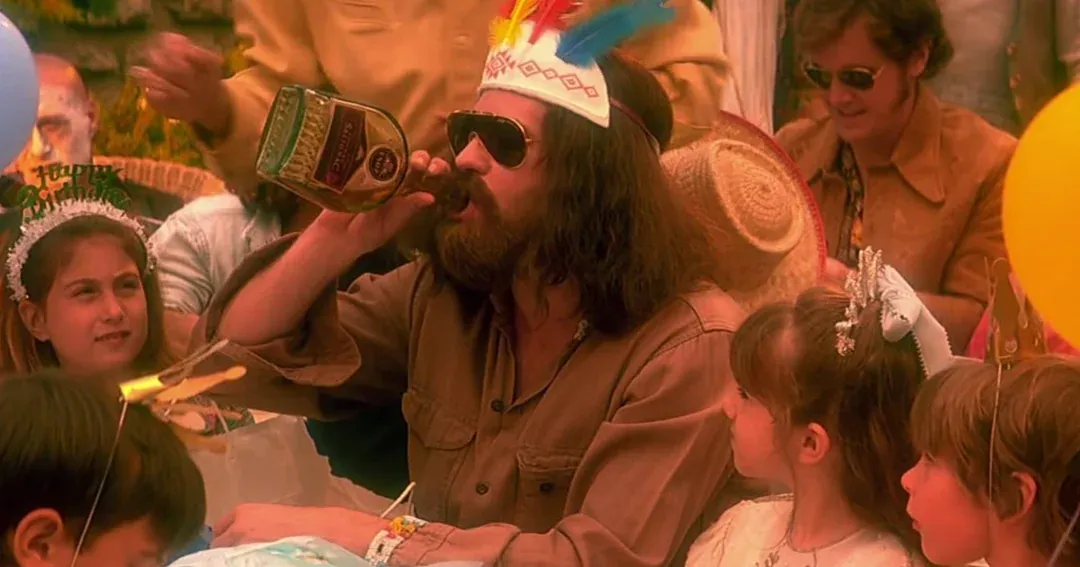
I wish Oliver Stone could understand how apt a metaphor it is, that there have been real Indians playing visions of Indians throughout this movie, but here's Jim Morrison at the end of his life and wearing a racist costume is the closest he'll get to who the people and culture those visions represent. But Stone couldn't put that together. He's the one who wrote and shot all those scenes where visions of Native American mysticism dance through a white guy's head. He thinks that shit's cool.
Manzarek, Krieger and Densmore all thought the movie exaggerated Morrison's alcoholism. So why do that? Why hold the guy up as a hero and paint him as a drunk asshole if you aren't presenting those things as contradictions? Because it feels clear Stone thinks all of the tortured artist crap resulted in amazing music, and it seems like he's sayin git was worth it. Stone makes movies where a lot of characters do a lot of things, but these movies could never be called "complicated." Thematically, he's never created a film more complicated than a sentence.
That's a big reason I still like The Doors: It shows a drunk buffoon without doing an adequate job explaining the complexity of his behavior. Kilmer hints at it, but Stone hasn't put any subtext into the movie. If the movie did a good job articulating why you should love Jim Morrison, if it had a cogent thesis, I'd have to actively disagree with it.
Natural Born Killers is the same way. I think that movie's arguments about violence and the media are either obvious or contrived, depending on the scene, but the editing is virtuosic. You could criticize it and say the film should have been an essay in a newsletter for Republican parents, but that movie had to be a movie. The editing is as much a part of the experience any dumb thing the characters say. When I watched Natural Born Killers, I enjoyed it because I wasn't trying to engage with its message, I was appreciating all of its surface-level qualities.
The Doors ends with two surface-level moments I find genuinely touching. And then the movie version of The Doors play "L.A. Woman" over the credits.
In the first moment, Meg Ryan's Pam Courson finds Morrison dead body in the bathtub of their Paris apartment. She asks him to stop joking around and then, over the course of a minute or less, realizes he's gone and cries, asking if he enjoyed his final high. The speed at which she turns from annoyed and kidding to understanding and despondent is almost inappropriately quick.
The art critic Dave Hickey wrote about hearing the news Chet Baker, another self-destructive musician who went out with a system full of heroin, had died. I believe this was originally published as an obituary, but I read it as part of his essay collection Air Guitar. Hickey got a phone call that Baker was dead, responded "Aw, shit" and hung up. Hickey recalled the story of John O'Hara getting a similar call about George Gershwin dying, but O'Hara had said "I don't have to believe it if I don't want to." Hickey was partially annoyed at himself for having so inarticulate a response to Baker's passing, but wrote that he couldn't have ever reacted as O'Hara had "because I believed it, and believing it, I sat there for a long time in that cool, shadowy room, looking out at the California morning."
Ryan encompasses that in a few minutes. She's surprised and then a switch flips and she remembers she's in love with Jim Morrison. How could you not expect him to overdose? His personality, art, everything was built around death and drugs and sex. Obviously he was going to die young. That nearly immediate recognition on her part is so sad.
After that scene, there's some quick documentary footage drifting through the graveyard Morrison's buried in, culminating in a shot of his graffiti-covered tomb. More than that, there's graffiti on all the graves around Morrison's. The first graffiti you see is an arrow on somebody else's headstone, pointing you to Morrison. And I wish Stone could put together how apt that metaphor is, too. Even in death, other people's peace is disturbed by virtue of their proximity to Jim Morrison.
That's what I take from it. We enjoy what we can in things.
Usually, you get this kind of intent/outcome distortion in documentaries. Pretty much every sports doc is about a person pushing their life to unsustainable places in pursuit of greatness. HBO's The 100 Foot Wave is a good example, a series about a person who neglects his family and regularly puts his life in danger even though he's got a bunch of kids to look after. I'm pretty sure the series thinks he's heroic. More recently, HBO had The Dark Wizard, about a free climber named Dean Potter who ruined all of his relationships and then died gliding in a wingsuit. He was 43. The series knows he's reckless, but it also seems to be portraying him as a man in search of transcendence, and who maybe found it. When The Dark Wizard shows first-person footage of his crash, which isn't explicit but which I wish I hadn't seen, it's hard to make the math pencil. He had some thrilling experiences, but so many of Potter's friends have died young and now he's smashed his head against a rock at only 43. Was that worth his lack of stable friendships and love? Could he have spent that time, I don't know, gardening? The documentary says he started chasing bigger thrills, employing laxer safety standards, but if he'd died free soloing, when he was at the top of his field, he'd still have died climbing. He'd still have robbed himself of decades of life. I don't know, I'd trade making it to my 90s for almost dying a bunch and then actually dying in my 40s.
One of my favorite examples of that distortion is a documentary called Approaching the Elephant, about the first year of the Teddy McArdle Free School in New York. The movie's on YouTube and Tubi and I haven't watched it since 2014, but I'd give it a recommendation. This place is almost a parody of an alternative school, where 9-year-olds decide amongst each other what they want to study. Their classes are voluntary and the rules are agreed on by the kids and teachers.
It's chaos. You feel terrible for the students, who get in fights with each other and spend an incredible amount of time hitting nails into wood. That's instead of reading and writing and whatnot. The kids want to drive nails through things so that's what they spend their days doing. It's what I would have wanted to do at that age, especially if my other option was learning long division, but at that age I also thought writing book reports seemed less stimulating than playing Diddy Kong Racing. I needed guidance then or I'd be functionally illiterate today. When one of the kids antagonizes the others, he needs counseling, and I'm sure it won't surprise you to hear he never gets it.
I watched Approaching the Elephant because my sister recommended it to me. She'd gone to a screening of it at her college, and that was followed by a talk from the film's director, Amanda Wilder, and one of the Teddy McArdle faculty members. My sister watched this cautionary tale and then the lights came up and, surprise, Wilder and the faculty member were dating and were much more positive about the school than you could have expected. The faculty member brought his kid, who also went to Teddy McArdle, and the kid kept running around the theater, yelling and touching things and interrupting everything anybody said. I'm jealous, of course. My sister saw a low-budget cinema verité documentary in 4D, with D-BOX seats.
There's an old cliche that it takes two people to make a great piece of art– one to actually craft it and one to hit the first person over the head and knock them out when they've finished. People don't know what they've got or how to edit themselves. I'm writing 4,000 words on The Doors, for example. But I also like your Approaching the Elephants or your The Doorseses, when the artists never stopped, never heard they should put their tools down. I like taking what I can from messes. And a messy movie about a messy singer, through the eyes of a messy filmmaker? That's self-reflexively indulgent enough to get 2 hours and 20 minutes of my time.
Some side notes:
- I've only watched one Oliver Stone movie outside of that class, and it was the best experience I've had with almost any movie. In 2012, my wife and I saw Savages at the Regal in Washington, DC's Gallery Place/Chinatown area. Savages was dogshit. In the first ten minutes of that movie, Blake Lively narrates "This is [Taylor Kitsch's character]. He doesn't have orgasms, he has wargasms." You won't get much out of the movie. But Johanna and I were sitting near the back of the theater and could see the entire place, and even though almost every seat was empty, there was a guy near the front and another guy right behind him. As loud as Savages was, we could hear front guy shout "Stop kicking my seat, man" at back guy, and then a few minutes later, front guy stood up, turned around, looked directly at still-seated back guy, and yelled "I don't care if I go to jail again, I'll kill you if you don't stop kicking my seat."
- When Stone came to speak to our class, we were told to not ask about his women characters being poorly written. He was sensitive to that criticism and a student at an earlier talk had probably broached the subject. He said nothing of interest. My friend David, who I didn't know at the time, attended the Stone talk because he'd taken the class a year earlier but Stone hadn't come to AU that year because he'd been filming Wall Street 2. David asked something about Stone choosing Nicolas Cage to star in World Trade Center and Stone said "I think he's a good actor" and went back to staring around the room.
- I did also see Daniel Ellsberg and John Dean through this class, and I did 10 hours or so of light research work for Dean at the National Archives. In lieu of being paid, he was supposed to thank me in the book he was writing, but I was working at a book store when it came out and he did not thank me. If you're ever holding a copy of John Dean's fortieth book about Watergate, go ahead and pencil my name into the Acknowledgements.
- I like Frank Whaley. You may have forgotten I said he played guitarist Robbie Krieger. The movie also forgets. He's really good in an underrated gem called Vacancy. "Underrated" like The Ruins or the remake of The Hills Have Eyes, meaning great, lean studio horror semi-trash I've seen a dozen times and would be fine seeing a dozen more. You can borrow my Vacancy DVD if you'd like.